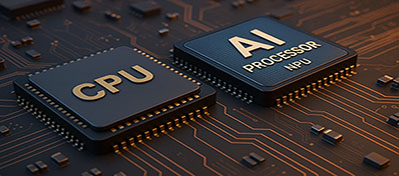
The AI Evolution of Processors: CPUs and NPUs

The AI Evolution of Processors: CPUs and NPUs

The rise of artificial intelligence (AI) is reshaping the desktop computing landscape, driving a new wave of innovation in processor design. At the forefront of this evolution are Intel Ultra processors and AMD Ryzen AI processors, which combine traditional CPU performance with powerful AI acceleration capabilities. This article explores how these two desktop processor families are redefining what modern computing looks like in the age of AI.


The influence of AI on processor development

AI workloads demand more than just raw CPU performance—they require intelligent processing capabilities, including real-time inference, deep learning acceleration, and energy-efficient parallel computing. This shift has led both Intel and AMD to integrate dedicated AI engines (NPUs) directly into their latest desktop chips.

Instead of relying solely on GPUs or cloud-based resources, users can now run AI models locally, enabling faster, more private, and more efficient experiences across tasks like image editing, voice recognition, code generation, and intelligent content creation.


What makes a great desktop AI processor?

To meet the complex requirements of modern AI workflows, desktop processors must deliver:

  1. Parallel processing efficiency
    Both Intel Ultra and AMD Ryzen AI chips feature multi-core architectures and embedded AI engines, capable of handling simultaneous tasks and complex matrix computations essential to neural network inference.
  2. Low power, high performance
    Efficiency is key. AI tasks can be demanding, and both Intel’s and AMD’s AI processors are optimized to deliver high throughput without draining system power—critical for both gaming and productivity use cases.
  3. Specialized AI hardware
    Intel Ultra integrates a next-gen NPU as part of its Meteor Lake and upcoming Arrow Lake architecture, while AMD’s Ryzen AI chips feature XDNA architecture, offering dedicated silicon for AI workloads.
  4. Integrated memory and bandwidth
    Fast access to data is vital for AI. These processors utilize advanced memory controllers and high-bandwidth interconnects to ensure rapid data movement with minimal latency.
  5. Future-ready scalability
    Whether you’re running small language models or powering AI-enhanced creative tools, both platforms are designed to scale with future workloads, supporting a broad range of AI applications.


Intel ultra desktop processors

Intel’s new Core Ultra desktop processors mark a major milestone. Built with a hybrid architecture, these chips combine Performance (P) cores, Efficient (E) cores, and a dedicated NPU designed for AI acceleration.

Key features include:

  • Intel AI boost: A new AI engine capable of accelerating tasks like noise suppression, background blur, and generative AI locally.
  • Meteor Lake and Arrow Lake platforms: Focused on modular chiplets, separating the CPU, GPU, and NPU into distinct tiles for better scalability and power efficiency.
  • Improved thread director: Optimized to allocate AI-heavy tasks to the most suitable core type in real-time.

These processors aim to bring AI-enhanced experiences directly to consumer desktops, from creative software to gaming enhancements and real-time collaboration tools.


AMD Ryzen AI Desktop Processors

AMD’s Ryzen AI desktop lineup, built on the Zen 5 architecture and powered by the XDNA NPU, is setting a new standard for local AI processing in consumer-grade systems.

Key features include:

  • Ryzen 9000 Series (expected AI variants): These chips are expected to include XDNA-powered AI engines, previously seen in mobile chips, bringing Ryzen AI to desktop PCs.
  • AI-native design philosophy: With XDNA, AMD integrates AI acceleration directly onto the chip, offloading neural tasks from CPU and GPU for better performance and lower power consumption.
  • Platform optimization: The Ryzen AI ecosystem works closely with software partners to optimize apps like Adobe Premiere Pro, OBS, and AI-enhanced assistants.

AMD’s strategy emphasizes balance—offering traditional raw power with cutting-edge AI capability, making Ryzen AI ideal for creators, developers, and power users.


Future trends in the processor market

As Intel and AMD ramp up their investment in AI silicon, several trends are defining the future of desktop processors:

  • Dedicated NPUs as standard: What was once a high-end feature is quickly becoming baseline. Expect every major desktop processor to include AI acceleration by default.
  • Local generative AI: Running AI models like Stable Diffusion or LLMs locally will become commonplace, enabled by these chips.
  • Smarter multitasking: AI will play a bigger role in resource scheduling, real-time performance optimization, and context-aware task handling.
  • Sustainability & efficiency: Energy-efficient AI computing will be key, particularly as generative tools become standard in everyday workflows.


Intel Ultra and AMD Ryzen AI processors are not just faster—they’re smarter. These chips represent the fusion of traditional desktop power with next-gen AI intelligence, bringing local inference, accelerated creativity, and more personalized computing experiences directly to your desk. Whether you’re building, creating, or gaming, the future of desktop computing is intelligent—and it’s already here.




Copyright © 2026 Tier one Distribution B.V. All rights reserved. All prices displayed throughout the site are exclusive of VAT.